

Files
Download Full Text (198 KB)
Description
INNOVATION & LEADERSHIP
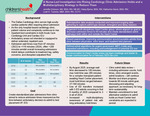
Background: The Dallas Cardiology Clinic, the only hospital-based clinic within the Heart Center’s outpatient network, serves specialized, high-acuity cardiac patients who often require direct admission. Due to inpatient bed constraints in the Acute Care Cardiology Unit and Cardiac ICU, rising patient complexity, patients are increasingly held in the ambulatory space, not intended for, or equipped for prolonged care. In 2024, average admission wait times rose to 118 minutes (often taking 200+ minutes) up from 97 minutes in 2022. Long admit wait times can lead to treatment delays, raise nursing concerns about safety, and disrupt outpatient flow. A gap in standardized admission approaches for both anticipated clinic admits and urgent patient event admissions. In response, a nurse-led initiative analyzed retrospective data to build consensus on the problem and organize a Heart Center -wide approach to improve timely, patient-centered transfers.
Implementation: A multidisciplinary Heart Center group aligned around gaps in the clinic admission process and the shared aim to reduce admission times (decision-to-admit to inpatient bed placement). Clinic admit data from 2018 was assessed with initial intervention to solidify data gathering in 2024 ensuring all admit type (known and emergent) and delay reasons were captured. As inpatient ADC continues to increase, the team recognized the need to develop standardized, scalable pathways utilizing bed locations both within the Heart Center and utilization of ED when beds are not readily available. Key improvements included enhanced communication around clinic admit potential to both the clinic team and inpatient bed planners; agreement in 60 minutes as a safe wait time for bed placement; and defined admit algorithms for urgent (post-event) and requested admissions. Go-live was Feb 2025; communication to Heart Center areas was initiated via team meetings and leader to leader communication.
Evaluation: Cardiology clinic admission data from 2018–2024 showed rising demand and wait times due to limited inpatient bed availability. In 2024, 66 admissions occurred with an average wait of 118 minutes. Maximum waits of 300 minutes happened multiple times, with only three patients transferred to the ED. By August 2025, average wait time decreased to 100 minutes. A transplant admission experienced a 265-minute wait, though most holds ranged from 37–190 minutes. ED transfers increased, with three occurring in the first eight months of 2025. These shifts reflect growing awareness of risks tied to prolonged ambulatory holds and a commitment to testing alternative solutions, as Heart Center bed constraints are expected to persist. Ongoing data review—including admission counts, hold times, and clinic emergent events—continues. Early findings suggest reduced delays and improved team coordination. Monitoring will assess progress toward the 60-minute transfer target and long-term sustainability.
Publication Date
11-24-2025
Disciplines
Pediatric Nursing
Recommended Citation
Dickson, Jennifer; Byrne, Haley; Harris, Katherine; and Toombs, Leah K., "A Nurse-Led Investigation into Rising Cardiology Clinic Admission Holds and a Multidisciplinary Strategy to Reduce Them" (2025). 2025. 1.
https://scholarlycollection.childrens.com/nursing-anf2025/1
Creative Commons License

This work is licensed under a Creative Commons Attribution-NonCommercial-No Derivative Works 4.0 International License.