

Files
Download Full Text (837 KB)
Description
INNOVATION & LEADERSHIP
Background: Literature suggests nursing students often enter pediatric clinical settings with limited exposure, heightened anxiety, and minimal preparedness for the acuity and complexity of pediatric care. Many academic programs lack adequate pediatric clinical hours, leaving graduates underprepared for practice. To address this gap, a pediatric hospital created two education development tracks for pre-licensure nursing students to foster early immersion.
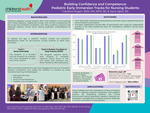
Implementation: Track one is a 10-week summer program for students who have completed at least one clinical rotation. Track two supports senior-level students to complete capstone clinical hours on the unit where they transition into Nurse Residency after graduating. Both emphasize readiness through early engagement and unit immersion, building competence and easing the transition to practice by using interactive learning methodologies. Each includes planned instruction, simulation, and direct clinical experience, aligned with pediatric core competencies for pre-licensure nurses. From 2023–2025, 149 students participated across both tracks, representing 30% of Nurse Residency participants. Educational outcomes were measured using pre- and post-program self-assessments adapted from a validated Pediatric Nursing Student Clinical Comfort and Worry Assessment Tool.
Evaluation: Students reported a 15% increase in confidence obtaining pediatric vital signs, a 74% increase in conducting head-to-toe assessments, and a 116% increase in navigating unit resources. Preceptor assessments showed 86% of participants were ready for independent practice in these skills, positioning them for competency validation during Nurse Residency. Beyond educational gains, program graduates had a 4% higher retention rate in Nurse Residency compared to non-participants. With an estimated $88,000 to train a new nurse, these outcomes represent $1.8 million in mitigated turnover costs. These findings show the implications of early immersion models in aligning academic preparation with pediatric practice. By integrating students into clinical environments before graduation, pediatric hospitals can strengthen competencies, accelerate practice readiness, and build sustainable nursing pipelines.
Publication Date
11-24-2025
Disciplines
Pediatric Nursing
Recommended Citation
Hogan, Candice and Iqbal, Sana, "Building Confidence and Competence: Pediatric Early Immersion Tracks for Nursing Students" (2025). 2025. 10.
https://scholarlycollection.childrens.com/nursing-anf2025/10
Creative Commons License

This work is licensed under a Creative Commons Attribution-NonCommercial-No Derivative Works 4.0 International License.