
Files
Download Full Text (741 KB)
Description
INNOVATION & LEADERSHIP
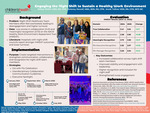
Background: Night shift nurses often feel overlooked, leading to disengagement and higher turnover. The common question, “What about for the night shift?” highlights gaps in recognition, communication, and collaboration. In 2024, a large pediatric health system launched a Night Shift Forum (NSF) to improve the work environment for this critical group. Results from the AACN Healthy Work Environment Assessment Tool (HWEAT) showed true collaboration (3.41) and meaningful recognition (3.73) as the lowest-scoring areas. Recent studies show that night-shift nurses consistently report lower scores on healthy work environment domains, while organizations with dedicated night councils demonstrate stronger staffing outcomes and lower turnover.
Implementation: NSF interventions were designed around the realities of night-shift practice. Communication guidelines addressed interdepartmental collaboration during overnight hours. An “Executive Spotlight” connected senior leaders directly with night staff, increasing visibility and dialogue. Meaningful recognition was emphasized through initiatives like the “Glo with Flo” Nurses Week celebration, held in the middle of the night so night staff could fully participate. Forum members volunteered at events, elevated concerns, and collaborated with respiratory therapy, pharmacy, and other disciplines to address barriers. These strategies directly targeted the lowest-scoring HWE domains while fostering cultural change and stronger connections across shifts.
Evaluation: The HWEAT was re-administered in 2025 and demonstrated measurable gains. True collaboration improved from 3.41 to 3.52, with RN–executive collaboration rising from 2.28 to 2.56. Meaningful recognition increased from 3.73 to 3.90, including advances in RN–executive recognition (2.322.57) and RN–manager recognition (3.203.34). Appropriate staffing, a well-documented night-shift challenge, also improved significantly (4.474.68, p=0.026). These results show that targeted leadership strategies can strengthen engagement, recognition, and collaboration for night shift nurses. For pediatric nursing, improvements in the work environment translate into stronger staff engagement, safer care, and better patient and family experiences.
Publication Date
11-24-2025
Disciplines
Pediatric Nursing
Recommended Citation
Walsh, Kelsey; Dewolf, Delaney; and Tolliver, Annie, "Engaging the Night Shift to Sustain a Healthy Work Environment" (2025). 2025. 19.
https://scholarlycollection.childrens.com/nursing-anf2025/19
Creative Commons License

This work is licensed under a Creative Commons Attribution-NonCommercial-No Derivative Works 4.0 International License.