
Files
Download Full Text (719 KB)
Description
QUALITY IMPROVEMENT
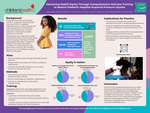
Background: Increased awareness of health equity and a rise in hospital-acquired pressure injuries (HAPIs) to the scalp and head—particularly among pediatric patients with textured hair—prompted a comprehensive initiative at a pediatric healthcare organization. Environmental scanning revealed that while new haircare products had been introduced into clinical areas, staff lacked the training and resources to use them effectively. A current-state analysis survey of 133 staff members (86% clinical) revealed significant gaps: 69% had never received training in diverse haircare, 51% did not feel equipped to provide appropriate care, and 36% felt nervous or intimidated when caring for hair types different from their own. Additionally, 50% lacked confidence in using products, and 43% didn’t know whom to ask for guidance. These findings highlighted the need for a structured, inclusive educational response to improve staff competence and patient outcomes.
Methodology: A transdisciplinary education subcommittee was formed, including NPDs, nurses, allied health professionals, instructional designers, and leaders in community relations and patient experience. The education lead, a member of the Haircare Equity Advisory Committee and coauthor of the clinical guidelines, helped guide the initiative. A literature review revealed minimal published training resources on diverse haircare, and benchmarking with four pediatric organizations provided context. The team developed a multi-modal learning strategy aligned with the organization’s mission. This included a culturally considerate flyer, tailored online courses for clinical and non-clinical staff, and 41 Haircare Champions across seven roles and 20+ practice areas. In-person “roadshows” offered low-fidelity simulations to reinforce learning and practice scalp assessments. Testimonial and demonstration videos supported just-in-time learning and sustained improvements in equitable haircare practices.
Outcomes: The initiative led to measurable improvements in staff confidence and patient safety. Post-training evaluations showed increased learner confidence and achievement of learning objectives. Predictive outcomes for trained clinicians rose from 31% to over 90%, reflecting a significant increase in preparedness. Most notably, the organization achieved a 0% rate of scalp and head HAPIs following implementation. The engagement of Haircare Champions and use of multi-modal strategies supported sustained practice improvements. Discussions around nursing-sensitive indicators, such as scalp hygiene and assessment, have increased, contributing to a more culturally competent workforce. In the first quarter post-training, over 3,700 diverse haircare products were used, and 75% of staff reported feeling very or extremely confident in caring for patients with diverse hair types. These results highlight the impact of inclusive education in advancing health equity and improving outcomes.
Publication Date
11-24-2025
Disciplines
Pediatric Nursing
Recommended Citation
Evans, Afra; Johnson, Adrienne; and Davis, Adrienne, "Advancing Health Equity Through Comprehensive Haircare Training to Reduce Pediatric Hospital-Acquired Pressure Injuries" (2025). 2025. 5.
https://scholarlycollection.childrens.com/nursing-anf2025/5
Creative Commons License

This work is licensed under a Creative Commons Attribution-NonCommercial-No Derivative Works 4.0 International License.