

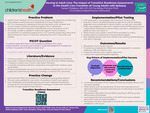
Moving to Adult Care: The Impact of Transition Readiness Assessments in the HCT of YAs with Epilepsy
Files
Download Full Text (435 KB)
Description
Practice Problem: Health Care Transition (HCT), the process of planning, preparing, transferring from pediatric healthcare and integrating into adult healthcare, is increasingly necessary as more adolescents with complex and chronic health conditions reach adulthood. Assessing transition readiness is identified as a key component of HCT. At a large, academic pediatric healthcare system, there was an opportunity to more consistently incorporate readiness assessments in HCT services of specialty clinics and determine the impact of readiness assessments on HCT outcomes. To address this, an evidence-based practice project was implemented using the following PICOT question: In patients ages 18-22 seen in the outpatient Epilepsy Clinic, does implementation of a structured transition readiness assessment increase the number of successful transfers to adult care? Successful transfer was defined as having a scheduled appointment in adult care. Literature/Evidence: Using OVID Synthesis and PubMed, a comprehensive literature review of 14 articles was conducted to explore use, role, and outcomes of transition readiness assessments in epilepsy and other pediatric patient populations. Across literature, evidence supported implementation of the Transition Readiness Assessment Questionnaire (TRAQ). TRAQ is the third iteration of a validated tool used internationally to assess adolescent and young adult HCT readiness using 20 questions, 4 domains, plus 2 questions on confidence and importance in managing health care. Practice Change(s): To identify and understand the impact of readiness assessments on HCT success, a practice change was implemented to begin administering TRAQ 5.0 to assess HCT readiness of young adult patients. This tool was available for use within the pediatric healthcare system. This practice change was adopted by clinic leadership and the interdisciplinary care team as the next phase of a long-term strategy to implement HCT services through cycles of improvement. Implementation/Pilot Testing: A 16-week pilot in the outpatient epilepsy clinic started in March 2026. Established patient ages 18-22 with an epilepsy diagnosis and a scheduled in-person follow-up visit with a provider were assigned TRAQ, in English or Spanish, to complete in the electronic medical record (EMR) patient portal within 7 days of the visit. If TRAQ was not completed prior to the visit, patients or parents/caregivers were directed to complete TRAQ at check-in using a tablet. Providers were able to view TRAQ results in the EMR. Weekly reports were utilized to track and monitor pilot progress. Updates were shared during monthly interdisciplinary care team meetings. Upon completion of the pilot, data was reviewed and analyzed to evaluate outcomes. Outcomes/Results:133 patients met inclusion criteria. 72 TRAQs were completed, with a 78% completion rate. Five referrals to adult care were made and four referrals resulted in scheduled or completed visits in adult care. Recommendations/Conclusions: Continued evaluation of the impact of readiness assessments on HCT is needed for patients with epilepsy and expanding to other complex and chronic diagnoses are future directions of this work. Other factors such as coordination of care and improvements in referral processes may also be contributing to successful HCT. Strategic alignment, physician and operational leadership support, and interdisciplinary collaboration are key drivers of successful implementation of practice changes targeting HCT services and interventions.
Publication Date
10-16-2026
Disciplines
Pediatric Nursing
Recommended Citation
Middleton, Tanika A. and McCool, shley, "Moving to Adult Care: The Impact of Transition Readiness Assessments in the HCT of YAs with Epilepsy" (2026). EBP Fellowship. 25.
https://scholarlycollection.childrens.com/nursing-posters-tcuebp/25
Creative Commons License

This work is licensed under a Creative Commons Attribution-NonCommercial-No Derivative Works 4.0 International License.