

Files
Download Full Text (265 KB)
Description
INNOVATION & LEADERSHIP
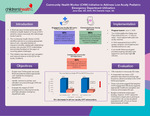
Background: A Medicaid payor-funded collaborative was initiated in partnership with Children’s Health System of Texas to reduce low-acuity emergency department (ED) visits—defined as triage levels 4 or 5—among Medicaid patients, who account for the largest share of ED use, with nearly 50% of visits considered low acuity. To address this, certified Community Health Workers (CHWs) were deployed in the Dallas and Plano EDs to engage eligible caregivers. CHWs provide education on insurance benefits, assist with establishing primary care provider (PCP) relationships, and promote appropriate healthcare utilization. They also work to identify barriers preventing the use of alternative care options (e.g., PCPs, urgent care) for non-emergent needs, while delivering feedback to the payor on recurring patient challenges. This initiative supports care navigation and aims to shift low-acuity care from the ED to more appropriate settings.
Implementation: The initiative was launched on June 4, 2024. Based on historical ED visit data, 10 CHWs were hired to provide coverage at the Dallas and Plano EDs from 9:00 AM to 11:00 PM, seven days a week—aligned with peak hours for low-acuity visits. A customized assessment tool was built into Epic to guide CHWs through caregiver conversations, helping identify reasons for the ED visit and uncover barriers to appropriate care. Assessment findings are reported to the payor, who uses the data to inform and initiate changes at the PCP level. In addition to in-person assessments, CHWs conduct follow-up phone outreach to families who visit after hours. Patients identified as high ED utilizers (three or more low-acuity ED visits within 12 months) are enrolled in a follow-up program offering up to six months of continued education and support aimed at promoting consistent primary care and reducing avoidable ED use.
Evaluation: Early results show a significant reduction in low-acuity emergency department (ED) visits. Additionally, a measurable decrease in ED utilization was observed among high-frequency utilizers enrolled in the CHW follow-up program. These outcomes suggest that targeted CHW engagement effectively supports appropriate healthcare navigation and reduces unnecessary ED use. Initial funding for the initiative was provided through a grant, and based on these promising findings, the payor and Children’s Health System of Texas are actively discussing expanding the CHW role and extending the program for another year.
Publication Date
11-24-2025
Disciplines
Pediatric Nursing
Recommended Citation
Neal, Jana and Hayle, Danielle, "Community Health Worker (CHW) Initiative to Address Low Acuity Pediatric Emergency Department Utilization" (2025). 2025. 12.
https://scholarlycollection.childrens.com/nursing-anf2025/12
Creative Commons License

This work is licensed under a Creative Commons Attribution-NonCommercial-No Derivative Works 4.0 International License.