
Files
Download Full Text (367 KB)
DOI
https://doi.org/10.63853/AHCQ1631
Description
INNOVATION & LEADERSHIP
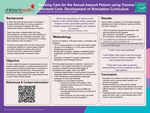
Background: In 1999, the American Association of Colleges of Nursing (AACN) called for nursing programs to include nursing care of patients who have experienced violence, including sexual violence. The care of these vulnerable patients requires specialized care, but also the use of specialized language through using trauma-informed care (TIC) to prevent revictimization and to further support healing. A simulation curriculum was developed that can both introduce the nursing care needed for a sexual assault patient and allow students to practice using TIC that is used when students practice independently as licensed nurses. Multiple studies have supported an increase in the self-confidence of nursing students who complete a simulation, and some have even shown an improvement in clinical skills practiced in the simulation. This simulation addresses the need for education for patients experiencing violence and helps guide students in using TIC to support the holistic care that nurses provide.
Implementation: A pilot simulation was implemented using 10 nursing students in their 2nd year adult health rotation. Groups of 3-4 students spent 15-20 minutes in the simulation and completed with group debrief. Directly after the simulation, students completed the Satisfaction and Self-Confidence Learning (SSSCL) tool. A pre-brief packet was given to students 1 week prior to simulation. This included information for counseling services as needed for psychological safety of participants, a paper “chart” and “MAR”, and articles on nursing care for sexual assault patients and providing TIC. In addition, 3 pre-briefing questions were completed and handed in to the facilitator the day of the simulation. The goal of this pilot was to provide the groundwork to implement this simulation in other nursing school programs and potentially branch out to new graduate nurse programs. This simulation could easily be changed to include different patient presentations, such as different genders or age.
Evaluation: Post-simulation, students completed the SSSCL tool which resulted in 100% of participants agreeing that the simulation was helpful and effective and that the teaching materials used were motivating and helped them learn (questions 1-5). A majority of participants (8) answered “strongly agree” to question 10 (It is my responsibility as the student to learn what I need to know from this simulation activity), and through the group debrief there was an overwhelming theme of participants enjoying that they got to practice hard to discuss topics or, as one participant reported, “I like that I was able to get the awkwardness out now instead of with a real patient”.
Publication Date
11-24-2025
Disciplines
Pediatric Nursing
Recommended Citation
Orr, Lauren, "Nursing Care for the Sexual Assault Patient using Trauma-Informed Care: Development of Simulation Curriculum" (2025). 2025. 33.
https://scholarlycollection.childrens.com/nursing-anf2025/33
Creative Commons License

This work is licensed under a Creative Commons Attribution-NonCommercial-No Derivative Works 4.0 International License.