
-
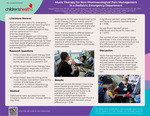
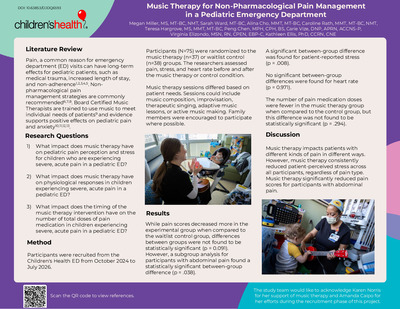
Music Therapy for Non-Pharmacological Pain Management in a Pediatric Emergency Department
Megan Miller, Sarah Ward, Caroline Rath, Teresa Hargrove, Peng Chen, Carie Vize, Virginia Elizondo, and Kathleen Ellis
-
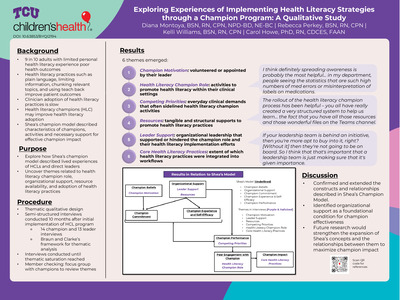
Exploring Experiences of Implementing Health Literacy Strategies through a Champion Program
Diana Montoya, Rebecca Perkey, Kelli Williams Williams, and Carol Howe
-
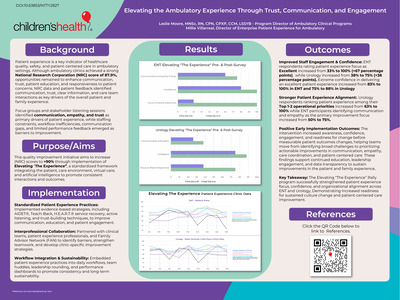
Elevating the Ambulatory Experience Through Trust, Communication, and Engagement
Leslie Moore and Millie Villarreal
-
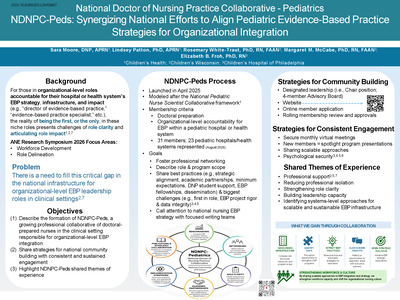
National Doctor of Nursing Practice Collaborative (NDNPC)-Peds: Synergizing National Efforts to Align Pediatric Evidence-Based Practice (EPB) Strategies for Organizational Integration
Sara Moore, Lindsey Patton, Rosemary White-Traut, Margaret M. McCabe, and Elizabeth B. Froh
-
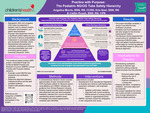
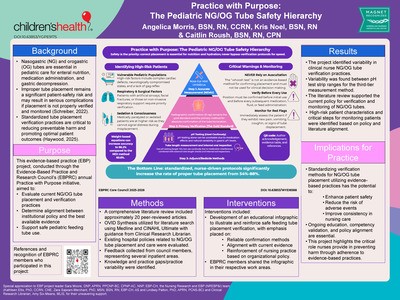
Practice with Purpose - The Pediatric NG-OG Tube Safety Hierarchy
Angelica Morris, Kris Noel, and Caitlin Roush
Lit Review: This evidence-based practice (EBP) project aimed to evaluate current NG/OG tube placement and verification practices and determine alignment between institutional policy and the best available evidence to support safe pediatric feeding tube use. This project was conducted through the Evidence-Based Practice and Research Council’s (EBPRC) annual Practice with Purpose initiative, which engages nurses in applying the EBP process to clinical practice questions. A comprehensive literature review of approximately 20 peer-reviewed articles was conducted utilizing OVID Synthesis. Existing hospital policies related to NG/OG tube placement and care were also evaluated. Feedback from council members, consisting of nurses representing several inpatient areas, was collected to identify knowledge gaps, practice variability, and barriers to consistent verification. Findings were synthesized to develop recommendations for standardized practice. PICO: In pediatric nurses caring for patients with nasogastric (NG) and orogastric (OG) tubes (P), can a review of the current evidence (I), compared with existing practice and educational resources (C), inform the development of an educational infographic (O) to reinforce adherence to the organization's NG/OG tube placement verification policy (T) during the project period? Results: The project identified variability in current verification practices and gaps between institutional policy and evidence-based recommendations. Findings from the literature review informed the development of an educational resource that included recommendations for standardizing NG/OG tube verification practices. Council members participated in creating an infographic to support consistency in practice and patient safety. This resource was shared by council members in their work areas and was presented during a monthly General Session meeting open to all nurses in this healthcare system. This project highlights the critical role of nursing in preventing harm through adherence to evidence-based feeding tube verification protocols.
-
Engaging the Nurse’s Voice - Committee Alignment in the Unit Practice Council.pdf
Kris Noel
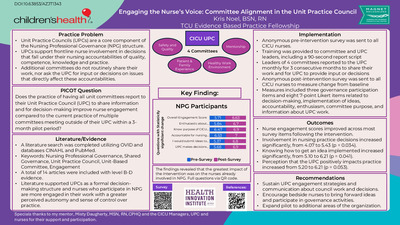
Lit Review: Literature Review: A comprehensive literature search used Library Services and OVID synthesis to search CINAHL and PubMed databases with the key terms: nursing professional governance, unit practice council, shared governance, unit-based council and engagement. Nursing Professional Governance (NPG) literature supports the UPC as the unit's decision-making body for nursing practice, quality, competence, and knowledge. Evidence also supports strengthening communication, frontline nurse participation, and accountability for unit-based practice changes through governance structures. Best practice indicates that committees should inform the UPC, bring forward concerns, seek input from council members, and return for decisions that fall within their authority. PICO: Does the practice of having all unit committees report to their Unit Practice Council (UPC) to share information and for decision-making improve nurse engagement compared to the current practice of multiple committees meeting outside of their UPC within a three-month pilot period? Results: An independent-samples t-test was conducted to compare pre- and post-survey responses. Nurse engagement scores improved following the intervention, with statistically significant increases in nurses' perceived involvement in nursing practice decisions and willingness to submit practice-improvement ideas to the UPC. Perceptions that the UPC made decisions that positively impacted practice improved. The results showed that nurses who participated in NPG activities had significantly higher overall engagement scores. Significant improvements were observed in understanding the role of the UPC, willingness to propose practice-improvement ideas, and accountability for nursing practice. Aligning committees through the UPC improved communication, increased visibility of committee work and strengthened nurse engagement in the CICU. This project supports the UPC as the decision-making body for nursing practice.
-
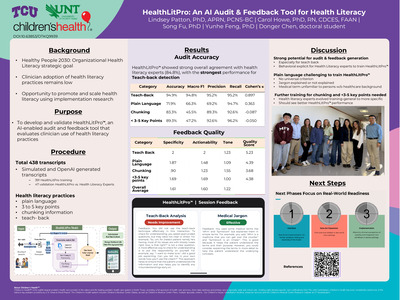
HealthLitPro: An AI Audit & Feedback Tool for Health Literacy
Lindsey Patton, Carol Howe, Song Fu, Yunhe Feng, and Donger Chen
-
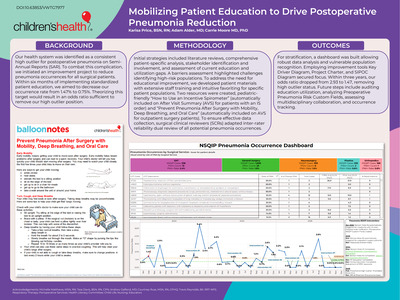
Mobilizing Patient Education to Drive Postoperative Pneumonia Reduction
Karisa Price,; Adam Alder,; and Carrie Moore
-
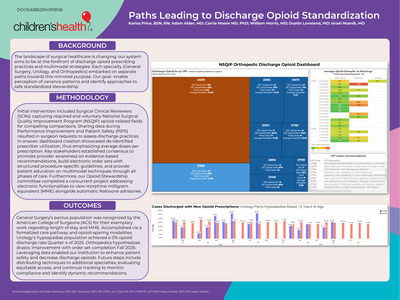
Paths Leading to Discharge Opioid Standardization
Karisa Price,; Adam Alder,; Carrie Moore,; William , Morris; and Israel Nosnik
-
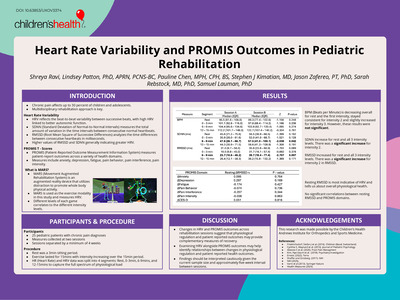
Heart Rate Variability and PROMIS Outcomes in Pediatric Rehabilitation
Shreya Ravi, Lindsey Patton, Pauline Chen, Stephen J. Kimatian, Jason Zafereo, Sarah Rebstock, and Samuel Lauman
-
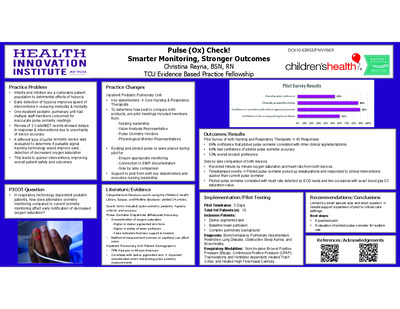
Pulse (Ox) Check! Smarter Monitoring, Stronger Outcomes
Christina Reyna
Lit Review: A comprehensive literature search using Children’s Health Library, Medline, and Scopus databases was conducted using key terms including pulse oximetry, pediatric, hypoxia, arterial, and accuracy. The search yielded 24 articles including systematic reviews and randomized controlled trial. Literature suggests that overestimation of oxygen saturation by pulse oximeters, particularly in hypoxic states, is higher in darker pigmented skin tone or states of lower perfusion. Readings may also be influenced by factors such as the method of oxygen saturation measurement (e.g., venous versus capillary). On the inpatient pediatric pulmonary unit, 76% of the patient population during 2025–2026 is Hispanic or African American which correlates with darker pigmented skin, making this an important consideration when interpreting pulse oximetry measurements. PICO: Literature shows that earlier detection of low oxygen saturation in the pediatric population allows for quicker interventions, improving overall patient safety and outcomes. On an inpatient pediatric pulmonary unit, there have been multiple instances of staff concern for inaccurate pulse oximetry readings. In one year, there were 3 code/MET events, in which uncertainty of device accuracy delayed response time and interventions. To address this problem, an evidence-based practice project was implemented using the PICOT question: In respiratory technology dependent pediatric patients (P), how does alternative oximetry monitoring (I) compared to current oximetry monitoring (C) affect early notification of decreased oxygen saturation (O)? A different type of pulse oximetry device was evaluated to determine if pulsatile signal tracking technology would improve early detection of decreased oxygen saturation. Results: Side by side comparison included recording minute by minute oxygen saturation and heart rate from both devices. Both nurses and respiratory therapists were surveyed during pilot with 45 total responses. Respondents had 89% confidence that piloted pulse oximeter correlated with other clinical signs/symptoms, 60% had confidence of piloted pulse oximeter accuracy, with an overall 53% product preference. The bedside staff recorded and/or time stamped desaturation event details, that allowed review of minute-by-minute data. These results indicated that the piloted pulse oximeter picked up desaturations and responded to clinical interventions quicker than current pulse oximeter. In addition, the heart rate detected by the piloted pulse oximeter correlated consistently with heart rate detected by electrocardiogram (ECG) leads and two occasions with exact correlation to blood gas O2 saturation value. Next steps include expanded pilot and evaluation of piloted pulse oximeter for system use.
-
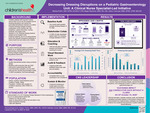
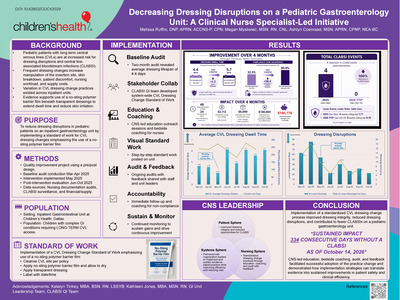
Decreasing Dressing Disruptions on a Pediatric Gastroenterology Unit
Melissa Ruffini,; Megan Mysliwiec,; and Ashlyn Coenraad
-
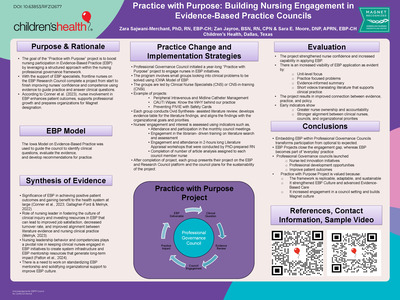
Practice with Purpose - Building Nursing Engagement in EBP Councils
Zara Sajwani-Merchant, Zan Jayroe, and Sara E. Moore
-
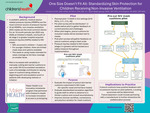
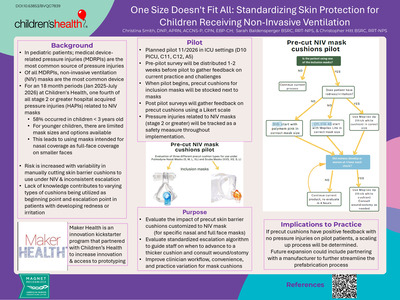
One Size Doesn't Fit All - Standardizing Skin Protection for Children Receiving Non-Invasive Ventilation
Christina Smith, Sarah Baldensperger, and Christopher Hitt
-
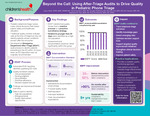
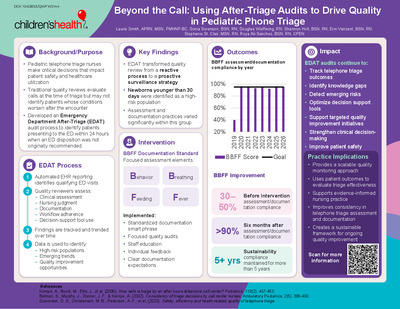
Beyond the Call: Using After-Triage Audits to Drive Quality in Pediatric Phone Triage
Laurie Smith Smith,; Sonia Sorenson,; Shannon Holt,; and Stephanie St. Clair,
-
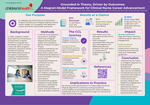
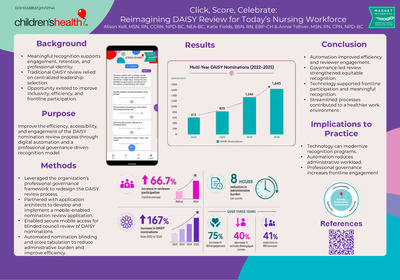
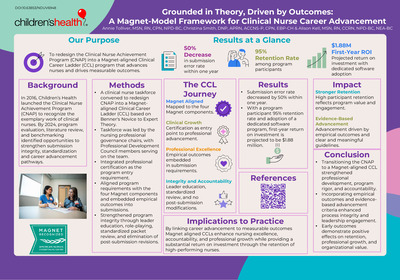
Grounded in Theory, Driven by Outcomes - A Magnet-Model Framework for Clinical Nurse Career Advancement
Annie Tolliver, Christina Smith, and Alison Kell
-
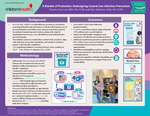
A Blanket of Protection: Redesigning Central Line Infection Prevention
Chasity Tyree-Lee, and Maci Wilbanks
-
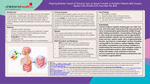
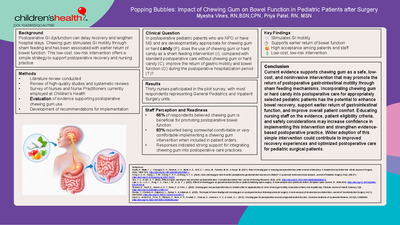
Popping Bubbles - Impact of Chewing Gum on Bowel Function in Pediatric Patients after Surgery
Myesha Vines and Priya Patel
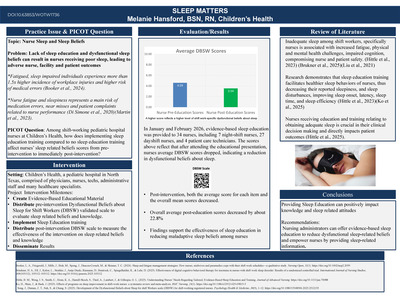
Lit Review: Delayed return of gastrointestinal (GI) is a common postoperative complication that can delay feeding progression and increase hospital stay. Evidence suggests that chewing gum acts as a form of sham feeding by stimulating the cephalic-vagal pathway and promoting bowel motility (Short et al., 2015; Roslan et al., 2020). Multiple randomized controlled trials and meta-analyses have demonstrated earlier return of bowel function, including reduced time to first flatus and bowel movement, among postoperative patients who chewed gum compared with standard care (Bhatti et al., 2021; Hsu & Szu, 2022; Liao et al., 2022). Studies show improvements in bowel function recovery and feeding tolerance, although findings remain mixed (Rehana et al., 2022; Fung et al., 2024). Clinical significance lies in the potential for nurses to implement a simple, low-risk intervention that may enhance GI, improve patient comfort, and support earlier progression of postoperative care. PICO: Problem: Decreased or absent gastric motility post-operatively Population: Postoperative pediatric patients who are NPO or have NG tubes that are age appropriate (not a Choking risk) Change: Historically, there has not been an intervention to assist in the return of gastric motility in postoperative pediatric patients. The intervention being considered is the introduction of hard candy or chewing gum for the age-appropriate patient to assist in return of gut motility. Outcome: Staff nurse survey to assess their comfort and knowledge in utilizing hard candy or chewing gum to assist in the return of gastric motility postoperatively. Results: A total of 30 participants responded to the pilot survey. Most of the participants were nurses from general pediatrics and inpatient surgery. About 66% of the respondents believed chewing gum is beneficial for promoting bowel function after surgery. However, inconsistency was found in the likelihood of finding chewing gum in orders. Nearly 83% were somewhat comfortable or very comfortable in implementing chewing gum if put in orders. Respondents believed the benefits of chewing gum is a low-cost easy intervention that will assist in return of gut motility post-surgery, may prevent nausea, satisfy hunger feeling, may increase satisfaction, may improve progression to regular diet, and prevent ileus. Barriers in implementation of this strategy include not properly entering orders, age of the patient, availability of gum, and choking hazard. Therefore, increasing awareness, developing age-related criteria, and guidelines for order entry can assist in resolving the identified barriers.
-
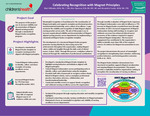
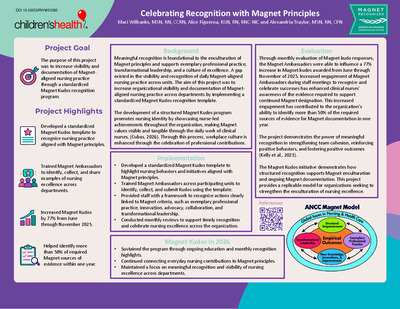
Celebrating Recognition with Magnet Principles
Maci Wilbanks, Alice Figueroa, and Alexandria Traylor
Printing is not supported at the primary Gallery Thumbnail page. Please first navigate to a specific Image before printing.